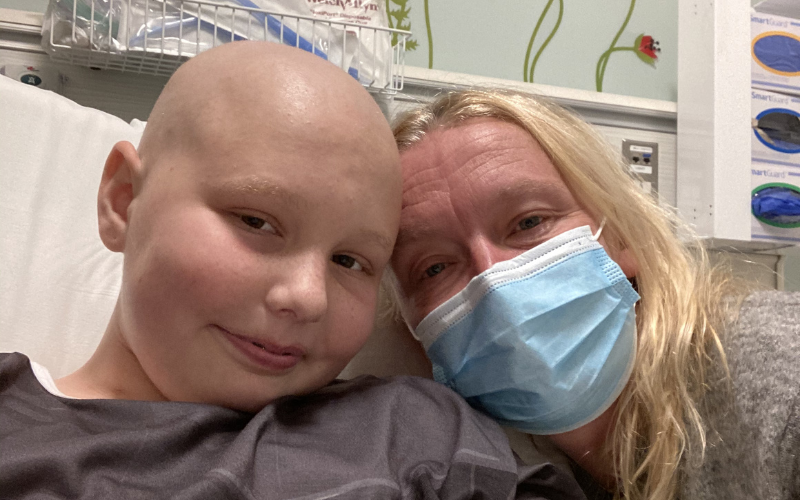
 Margaux was diagnosed with dysgerminoma, a rare ovarian cancer, at age twelve.
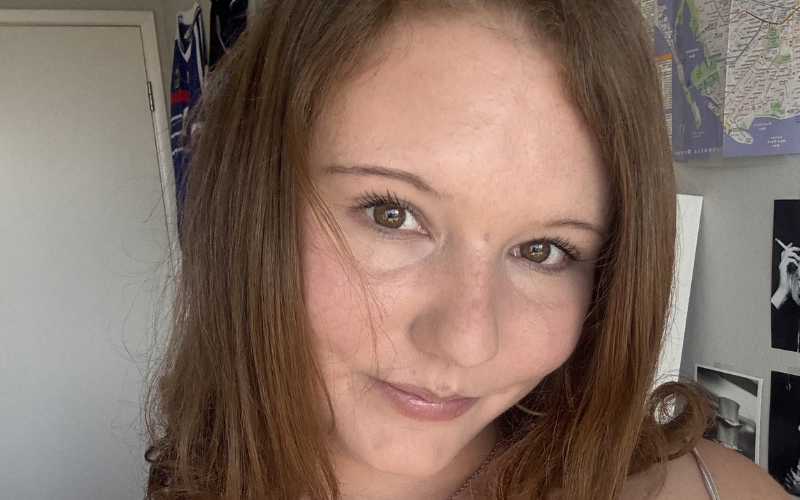 Margaux is now 17 years old and a senior in high school
By: Margaux Quereuil
There is a particular kind of loneliness that has nothing to do with being alone.
I was twelve years old when I was diagnosed with dysgerminoma, a rare form of ovarian cancer. It was September 2020 — the height of the pandemic — and no visitors were allowed into my room at Sutter California Pacific Medical Center. No brother, no friends, no other patients. Just four walls and a sixth-floor window overlooking the Geary and Van Ness intersection. I would watch the pedestrians below, moving through their ordinary evenings, and feel the distance between us like a physical weight.
On day two of chemotherapy, I wrote in my journal: "Sometimes I wish I could wake up from this nightmare and it would all be over. I'm getting sick of these walls."
This is what they don't tell you about cancer. They don't tell you that you can be surrounded by people who love you more than words can express — who send flowers and write cards and sit by your side —and still feel more alone than you ever have. The loneliness isn't about the absence of people. It's about the absence of people who truly understand.
Childhood cancer awareness, to me, means telling the truth about that.
It means acknowledging that treatment does things to you that nobody warns you about. It took months of my life with four walls and a phone screen and the particular agony of watching the world continue without you. It changed my body in ways I am still learning to live with — the scar on my chest, the curls that grew back differently, the hypervigilance that doesn't just switch off when you're declared healthy.
Awareness means understanding that "cancer-free" is not the same as "okay," that survivorship is its own complicated country, and nobody gives you a map.
It means being angry, too. Not at what happened to me — I've made a kind of peace with that — but at what could be different and isn't. While researching pediatric cancer, I understood that more than half of people with cancer experience significant isolation during treatment. And yet the gap between what we know and what we build for the people living it remains enormous.
Most of all, childhood cancer awareness means refusing to let that gap go unspoken.
That search for answers eventually led me to Alex's Lemonade Stand Foundation, where I connected with Heather Banaszek, whose son CJ was diagnosed with leukemia at eleven. Her words have stayed with me: "You can be in a room full of people and feel completely alone. No one truly understands unless they've been through it."
She's right. And that's exactly why it matters to say it out loud.
I am seventeen now. I beat cancer. And I am writing this because somewhere, there is a twelve-year-old staring at a hospital ceiling who needs to know that someone understands — that what they are feeling is real, and that they are not alone.
About Margaux
Margaux was diagnosed with dysgerminoma, a rare ovarian cancer, at age twelve. She underwent surgery to remove her right ovary and several rounds of chemotherapy over four months in 2020. She is now seventeen, a senior in high school, and cancer-free. She has spent the past year researching social and emotional isolation in pediatric cancer patients — work that led her to Alex's Lemonade Stand Foundation, where she serves as a new Hero Ambassador. Next year, she will attend UC Berkeley. Her hope is that her story offers other children facing cancer what she once needed most: the knowledge that someone understands.
About Dysgerminoma
Dysgerminoma is the most common malignant ovarian cancer in children and adolescents. While ovarian cancer in children is rare overall, over 350 cases are diagnosed each year.