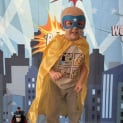

The ALSF Centers of Excellence grant program has increased the number of clinical trials and helped real kids get their cures, like little Josie (above), who thanks to COE funding, was able to access a life-saving trial close to home.
By: Trish Adkins
Every breakthrough in childhood cancer starts the same way: with someone choosing to act — whether it's a researcher with a bold idea or a donor committed to giving kids a chance at a cure.
Alex’s Lemonade Stand Foundation (ALSF) founder Alex Scott believed if we all worked together, we could make a difference for kids with cancer, and when it comes to childhood cancer research, nothing could be truer. Childhood cancer research needs the brightest minds, the most curious investigators, and the most generous supporters to power it forward toward cures.
“This research is difficult because it’s a rare disease,” said Katie Janeway, MD, an ALSF-funded researcher. “But we know how to do this work. When it’s well-funded, we can complete the work and it will increase cure rates for sure.”
Here are seven essential facts about how childhood cancer research is funded:
1. Federal grants offer the largest awards — but childhood cancer receives the smallest slice.
Despite giving childhood cancer research the smallest portion of its cancer budget, the National Cancer Institute (NCI) provides the largest research grants for pediatric cancer. NCI grants can range from $500,000 to over $7 million for large cancer centers. However, this funding alone is not enough to meet the urgent needs of children with cancer.
2. Most researchers rely on multiple funding sources.
Researchers use a patchwork of support to power their work. Open any academic journal and the “Acknowledgements” section tells the story: large nonprofits like ALSF, smaller family foundations, federal funding, pharmaceutical partners, and individual donors all make critical contributions.
3. Early-career grants are some of the hardest to secure — ALSF fills this gap.
Research funding for scientists just beginning their own labs has been inconsistent and can often fuel uncertainty at critical times in a young researcher’s career. ALSF has long supported early career researchers through several grant categories including Young Investigator (YI) Grants that provide critical support for preliminary studies and preclinical work that is needed for future application to federal research grants.
“ALSF has made it possible for me to see that my project has efficacy in a preclinical stage before I advance it forward into clinical trials for our children. I'm really grateful for this,” said Angela Liou, MD, a YI recipient from Sanford-Burnham Medical Research Institute.
4. Cross-disciplinary, multi-institutional work is essential.
Collaboration is often the key to solving the toughest childhood cancers, yet these projects are among the hardest to finance. ALSF’s Crazy 8 Initiative directly addresses this gap. So far, ALSF has invested $35 million and funded eight large, interdisciplinary teams across 28 institutions, all focused on tackling the most intractable problems in childhood cancers.
5. Infrastructure funding is critical to launching clinical trials.
Through the ALSF Centers of Excellence (COE) program, four childhood cancer hospitals are provided with infrastructure funding that supports the start-up and design of multisite clinical trials, training of future clinical trial lead investigators, and drug development. This program has increased the number of clinical trials and helped real kids get their cures, like little Josie, who thanks to COE funding, was able to access a life-saving trial close to home.
6. Drug development for pediatrics is challenging, but researchers (and legislation) are helping.
Beating childhood cancer with fewer long-term side effects depends on having more safe, effective drugs for kids. But progress is slow. From 2020–2025, only 53 of 318 FDA cancer drug approvals were for children, and kids still wait about 6.5 years longer for new treatments. Few trials include them — only 17% of 26,000 active U.S. cancer trials enroll children.
Several factors cause delays: limited federal research funding, low pharmaceutical investment, small patient numbers, difficulty creating kid-friendly drug forms, language and cultural barriers, and limited access to pediatric research centers.
There is good news: researchers are improving trial designs, and policies like the 2017 RACE for Children Act — which requires testing adult cancer drugs with targets relevant to kids — are helping. Since 2020, more new drugs are being tested in children earlier in the process.
7. It’s more than medical research — It's data, too.
This year the Federal government increased its commitment to using data and AI to power pediatric cancer research. ALSF also supports data through the Childhood Cancer Data Lab. constructs open-source tools like the Single-cell Pediatric Cancer Atlas and refine.bio to make vast amounts of data widely available, easily mineable, and broadly reusable. It also trains researchers and scientists to better understand their own data and to advance their work more quickly.
8. You are part of the research process: advocacy, fundraising and making donations to research to help more kids.
Because of your support, ALSF has been able to fund more than 1,500 grants at nearly 150 institutions, powering hope and cures for all children with cancer.
About the ALSF Grant Program
The ALSF Grant Program funds research every step of the way—from early-stage innovative research all the way through to life-saving clinical trials for kids with cancer. ALSF’s initiatives are having an impact on research worldwide. The Crazy 8 Initiative is bringing together the brightest minds from around the globe to fight childhood cancer. ALSF is also one of the only childhood cancer research organizations that has been given the NCI peer-reviewed funder designation for rigorous selection of research grants.
When you donate, you are a part of the cutting-edge research breakthroughs that will ultimately help kids beat cancer.