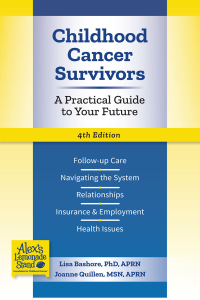
Childhood Cancer Survivors
Advocacy
Cancer is a life-transforming experience. After treatment ends, many survivors want to contribute or give back to the cancer community. No matter what your education, experience, or time restrictions, there is much you can contribute to others if you choose to advocate.
Survivors and their families have the potential to effect individual, institutional, and social change. Advocacy means using the things learned from your personal experience and joining with other survivors to help change the laws and healthcare rights/regulations to provide you or other survivors what you need to live the healthiest life possible. Sometimes this consists of educating health professionals, politicians, or society at large. It can mean setting up a peer support network, whether it consists of two survivors who meet for coffee once a week or an organization with thousands of members. It can take a little time or become a focal point of your life.
It is hard for our daughter to fathom the reality and responsibility of being a cancer survivor. She was diagnosed at just three years old. As her parents, we have tried to take on as much as we can so as to not burden her as she continues her cancer journey. Even when treatment is over, though, it is never fully “over.” Our journey was never easy, but we are forever grateful that our daughter is in remission.
We now feel that we have a responsibility to educate people about the facts of childhood cancer. It isn’t that rare, but people sometimes do not understand much about it or don’t want to think about it because it is such an unpleasant topic. Whether it is spreading the word that childhood cancer research is underfunded, volunteering at an event, or educating people about childhood cancer, we strive to give back as well as educate others. Our advice to all going through this awful journey - know you are not alone, everyone’s journey is different, and never, ever give up hope.
I had acute lymphoblastic leukemia and was treated from the age of four to six years, from 2004 to 2006. My treatment began at the same time that Alex’s Lemonade Stand Foundation was establishing itself as an official 501(c)(3) non-profit. I visited multiple lemonade stands during my treatment, and have felt very connected to the foundation over the years having supported many fundraisers. I always stop when I see a lemonade stand and am happy to support such an important mission.
We are now grateful for every tiny thing in life. We also cherish our precious time together, as we have stood at the edge, looked over, and seen how life could be without our beloved daughter. We always set aside time for family dinners, family events, and simply talking with each other. We also realize how vital it is to advocate for children with cancer -- whether it is giving back to all of the organizations that helped us survive, volunteering, or spreading the word that childhood cancer is not rare and that research is severely underfunded.
I want to express my appreciation for Alex’s Lemonade Stand Foundation. ALSF stands for everything I stand for. As a survivor, it really helps to know that there are non-profit organizations like ALSF whose sole motivation is to help cancer patients, cancer survivors, and their families and make treatments safer. It is reassuring to know that there are organizations who don’t care about the money aspect and just care about helping people.
Individual advocacy
Individual advocacy means being able to stick up for yourself in order to get what you need for the rest of your life. You need to learn how to work within the system to get the best healthcare, an appropriate education, and a job without discrimination based on your cancer history.
Obtain detailed medical records of your cancer treatment. The first step in being the best advocate for you or your child, is to obtain the medical details of your/your child’s cancer history and treatment, and educate yourself about the risks and possible late-effects to expect from that type of treatment, continuous tests and monitoring that is necessary, and where to access these resources.
Unfortunately, I am one of many survivors who has to deal with long-term severe and permanent medical effects. During the time leading up to my diagnosis at age 9 until today, my parents allowed me to give my opinions and advocate for myself. I am extremely fortunate and thankful and urge any parent whose child is facing challenges similar to mine to do the same. Having to make decisions that would impact me not just in the moment but my whole life really forced me to grow up. Some may see this as tragic, but having that autonomy and self-awareness at a young age has been critical for my self-advocacy and my medical journey as a teenager and young adult.
Because knowledge and studies regarding late-effects of treatment and cancer survivorship are growing daily, you should be seen at least yearly by a healthcare provider (preferably in a survivorship clinic) who keeps updated on the latest studies, research and information or by a provider who is in close communication with a survivorship expert. You should remain active in your follow-up care, especially since other symptoms may develop over time.
It can be a heavy load to be an advocate in the healthcare system, school, and community. However, much satisfaction can result. The following is a list of activities you and/or your family can do to advocate for improvements.
Advocacy Activities:
Obtain copies of your records and/or treatment summary in order to advocate for your future healthcare.
Work with the school to get your child an IEP or 504 Plan to get the best possible education.
It is helpful to have your own record of the types of treatments and/or surgeries and dates. Request a copy of your cancer treatment summary and medical history from your survivorship or treatment provider. See example of Cancer Treatment Summary by Children’s Oncology Group:
From the beginning, we’ve had to advocate for proper accommodations at school for my daughter. When anyone sees brain tumor, they assume so many things; other times teachers see she had cancer so long ago that they assume everything is okay. She has also had to learn to advocate for herself. And since this has been her entire life—she’s pretty good at it. She’s taken the lead on researching services at college—and I hope she continues to be the fierce self-advocate she has been in high school.
Register with the office for students with disabilities at the college or university.
Challenge rules that restrict the options of survivors.
Volunteer to staff a local organization’s cancer information line.
Start a support group in your community or hospital.
Talk to local civic groups about your experience.
Write letters to newspapers, magazines, or politicians about survivorship issues.
Share your experience with the media or legislatures to help shape public opinion or policies about cancer.
Become a counselor at a camp for children with cancer.
Offer to be a support person for newly diagnosed families.
Join or start committees to effect changes at your hospital.
Donate to groups that lobby for survivors.
Help fundraise to start or sustain a comprehensive follow-up clinic.
Participate in follow-up studies that may be available through a comprehensive follow-up clinic. Information from these studies can have impact through publications, media attention, and public policy change.
Tell your friends and family your feelings about your cancer journey.
Advocacy is not for everyone. Sometimes survivors just want to carry on with their lives. Over time, you may have greater or lesser interest in your cancer history.
Group advocacy and networking
Networking with other survivors and advocating for change will help survivors following in your footsteps. Group advocacy can be very effective in encouraging and creating change at the community, state, or national levels. Issues that can be addressed are national funding (e.g., increased monies needed for late effects research), institutional funding (e.g., starting and supporting comprehensive follow-up clinics), political changes (e.g., improving anti-discrimination laws), federal and state programs (e.g., improving insurance options for survivors), and hundreds of others.
Group advocacy opportunities. The following are some of the ways for groups to effect changes.
Start an online support group.
Organize a conference at a treating facility to educate caregivers about survivorship issues.
Lobby an institution to provide comprehensive services for survivors.
Attend local, state, or national gatherings of survivors.
Encourage family and friends to create or join committees that work for survivor issues.
Table of Contents
All Guides- Acknowledgements
- Contributors
- Foreword
- Preface
- 1. Survivorship
- 2. Emotions
- 3. Relationships
- 4. Navigating The System
- 5. Staying Healthy
- 6. Genetic Testing And Childhood Cancer
- 7. Diseases
- 8. Fatigue
- 9. Brain And Nerves
- 10. Hormone-Producing Glands
- 11. Eyes And Ears
- 12. Head And Neck
- 13. Heart And Blood Vessels
- 14. Lungs
- 15. Kidneys, Bladder, And Genitals
- 16. Liver, Stomach, And Intestines
- 17. Immune System
- 18. Muscles And Bones
- 19. Skin, Breasts, And Hair
- 20. Subsequent Malignancies
- About The Editors