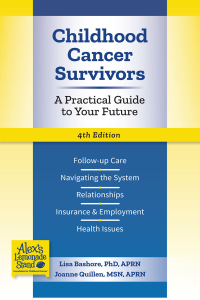
Childhood Cancer Survivors
Survivorship
The word survivor can have many different meanings depending on one’s particular situation in time. There are many types of survivors but survivor refers to someone who survives an experience that has completely disrupted their life at a certain point in time, such as a personal tragedy or traumatic experience, a natural disaster (earthquake, tornado or flood), or those like you who have undergone treatment for an injury/cancer and been cured. In this book, we are going to refer to survivorship as the point in life when your cancer treatment ends and the journey into the future begins.
You are part of a growing community of children, teenagers, and adult survivors of childhood cancer who are pioneers in the post-treatment journey into adulthood. In the months and years after treatment ends, you may encounter physical late effects, emotional upheaval, and unexpected benefits.
Your journey may be easy or hard. It may take surprising turns and dips and reach dizzying heights. Although thousands of others make similar journeys, your path will be unique to you.
Life for all people is sometimes rocky and sometimes smooth. Being a survivor may throw a few unexpected stones in your path or may pave the way to new opportunities. Many survivors talk about how cancer opened their eyes and left them with an appreciation for life. They are able to shake off the small stuff and focus on the important things in their lives. They feel as if the cancer gave them perspective, and that this is a great gift. Others feel that the cancer was one small part of their lives and they prefer not to think about it. As time goes by, your feelings about the experience may change.
Being a childhood cancer survivor has shaped every aspect of my life, both the great parts and the hardships and is core to my identity. Enduring my diagnosis, treatment, and resulting complications, both physical and mental, has been and will continue to be the greatest challenge.
Despite these extreme difficulties, cancer either directly or indirectly has also brought me my greatest joys. My partner, my career, and the people and causes I choose to associate with have all come into my life as a direct result of my survivorship. These are people, activities, and causes I cherish and have given great meaning and purpose to my journey. Navigating these hardships is not as painful with the help of my support system. My advice is to embrace the survivorship club with open arms because it will lead you to great things and beautiful people.
My whole perspective on life has changed. I realize how precious life is and how much beauty can come from pain. It’s a lesson I wish I could have learned in a different way, but it is also something I am thankful to have learned. I see so much more value in my life and what I can do to help others. I live every moment of my life to the best of my ability. Life is so short, and it can change in the matter of an instant.
I have learned that it’s OK to have bad days, it’s OK to be upset or angry, it’s OK to let people help you. As a survivor, I am so much more than what I’ve lost – I am so much more than cancer.
Being a cancer parent is such a roller coaster of emotions. We struggle with sadness and anger about what cancer has done to our child and family and yet, at the same time, we are full of gratitude for how far she and we have come since the day of diagnosis.
Being a childhood cancer survivor is a unique experience. Some days I don’t think about it much at all, while other days it’s hard not to feel the effects of it. I have personally found the psychological side effects, like anxiety, depression, and guilt, to be harder to manage than my physical health. My advice to other survivors: try and seek mental health support, even if you don’t think you need it. It is helpful to have someone to talk to and talk over your complicated feelings.
Being a childhood cancer survivor comes with a lot of responsibility. Like it or not, we are the ones looked up to by the children currently going through treatment. This can absolutely be daunting, stressful, and quite overwhelming. However, it can be an exceptional blessing. I was constantly inspired by the survivors I met and they allowed me to visualize myself as a survivor too someday.
Since being pronounced cancer-free, I have had wonderful opportunities to give back to organizations that helped me throughout my treatment. This has truly been life-changing for me and allowed me to fully embrace the responsibility of helping other children the way I was helped.
Part of surviving childhood cancer is dealing with and educating medical personnel, family, friends, and loved ones about the medical and emotional aspects of survivorship. You may find that family members want to pretend it never happened. You may be told to put it all behind you and not think about it. Or you may find people treating you as if you are a fragile piece of glass. Deciding what parts of your cancer history to explain and what parts to ignore may take some reflection, and will certainly involve planning how to communicate your thoughts and needs to loved ones. This topic is discussed more in Chapter 2, Emotions, and Chapter 3, Relationships.
Transition into survivorship
According to Webster’s New Collegiate Dictionary, transition is a “passage from one state, stage, place, or subject to another.” This definition expresses very well the road that survivors of childhood cancer travel, from active treatment, to off-treatment, and then from off-treatment to long-term survival. The definition also fits because the “place” of healthcare changes as the adolescent moves from pediatric healthcare overseen by parents to self-designed and self-monitored adult healthcare. These periods of change can evoke anxiety and require a period of adjustment. For survivors, transitions involve medical, psychological, social, and educational changes.
After treatment I have been involved with two key organizations that were and are an important part of my support network, The Hole in the Wall Gang Camp and Alex’s Lemonade Stand. These organizations brought the major members of my support network into my life. Those weeks at camp were always my happiest of the year. I spent time with and shared with other people my age going through similar experiences. Through those years, I met people that continue to be my best friends and my partner of 8 years. These people lift me up and support me every day. I owe a great deal to these communities for helping me through incredibly difficult transition periods. I encourage all survivors and their families to find similar support systems.
I found a lot of support through other childhood cancer families at Alex’s Lemonade Stand Foundation. This was especially true when I was younger and continues to be. I also have support groups through my para-rowing sports and Camp Hole in the Wall Gang. Most kids there are cancer survivors which gives me joy because I don’t need to explain myself or my life. There’s no pressure because we’re all there for the same reason.
People cope better with transitions if a period of planning occurs before the change happens. The transition from cancer patient to survivor should be acknowledged by all healthcare providers, and the psychosocial and educational aspects of survival should be addressed. For instance, if a teen’s medical care shifts from a pediatric clinic to an adult clinic without discussions about his understanding of his disease, he may still have only the information that was given to him when first diagnosed as a young child. This is hardly the amount or depth of information needed by a survivor entering adulthood who will have to advocate for his own healthcare and make wise lifestyle choices.
The following sections discuss going off-treatment and moving from teen to adult healthcare.
End of treatment
The last day of treatment is a time for both celebration and fear. The protocol schedules and frequent appointments provided reassurance and structure. While most families are thrilled that the days of pills and procedures have ended, some fear a future without powerful medicines to keep the disease away. Concerns about relapse are an almost universal response, and family members often feel vulnerable after active treatment ends.
Many parents and survivors describe ending treatment as almost as wrenching an experience as the diagnosis. Families begin to experience the gamut of emotions—from elation to terror—months before the final day.
Survivors and their parents should anticipate that after months or years spent going through the rigors of treatment, they will have lost the feeling of a normal life. They may experience relapse scares and need to call the doctor to describe the symptoms and be reassured.
With diagnosis came the awareness that life can be cruel and unpredictable. Because many parents and children feel that treatment is keeping the cancer away, the end of treatment sometimes leaves families feeling exposed and vulnerable, and thoughts of “what’s coming next?” When treatment ends, survivors and their parents must find ways to live with uncertainty, to find a balance between hope and reasonable worry.
I was diagnosed with acute lymphoblastic leukemia at age 4 and my treatment ended when I was 6. I went through some strange emotions then. I was happy because I felt better, could move better, and could do so much more than during my treatment. A lot of my first memories were of treatment years in the hospital, so when everything supposedly went back to “normal”, it was a lot to adjust to.
My transition from being on a full-time treatment schedule to not having any at all has been overwhelmingly hard. I struggle a lot with anxiety, and knowing that I was not going to be getting life-saving treatment anymore made me very fearful that my cancer would come back. Of course, I was so happy to finally be done with the harsh treatments, but it also felt as though my safety net was gone. Our minds are powerful things, and anxiety creeps in whenever it wants to, so therapy was/still is an awesome outlet for me to express my worries and feelings.
Ending treatment was and still is a combination of relief and anxiety. Relief that treatment is complete, grief and sadness over all the internal damage and the loss of many loved ones to cancer including my grandmother. “Normal” does not exist for me, but I embrace being different and being me.
We have been so fortunate to have both healthy girls since finishing their treatment. They were both babies during treatment and have no recollection of the hell they went through. They are too young to know or worry about relapse. We are still uneasy at these follow-up visits but our confidence that there is no reoccurrence overshadows our fear of relapse.
It was a little strange to transition from being in-treatment to off-treatment. I was ecstatic to make the transition, but there were kids at school who still felt like they needed to walk on eggshells around me, even though I was in remission and could fully participate in whatever activities were taking place. After a few weeks, however, everyone began to adjust, and it was a much more inclusive and positive experience.
Transitioning off treatment was exciting, but also resulted in a bit of a culture shock. After spending a year almost entirely in the hospital surrounded by the same few people every day, transitioning back to a “normal” routine especially going to school regularly was a bit overwhelming. I was stuck in the middle of wanting to be treated as normal by my peers, while at the same time expecting to receive the same one-on-one attention from adults I was used to in the hospital. This dichotomy made me feel like I was being pulled in several directions emotionally and was tricky to navigate as a young girl.
End-of-treatment meeting with healthcare team
Doctors and nurses can help with the transition to survivorship by having a meeting with the family before the initial appointment with the Survivorship Clinic. The appointment should be long enough to allow a lengthy conversation.
Topics discussed during your first transition meeting to survivorship might include:
The disease, the treatment, and possible late effects
When and who to call with specific questions and concerns, including a written list of symptoms that should prompt a call
Detailed discussion of the next steps: which healthcare providers will see your child, the appointment schedule, the follow-up schedule, and what (if any) immunizations to get.
A detailed cancer treatment summary document (Download a copy of Comprehensive Cancer Treatment form used by the Children’s Oncology Group (http://www.survivorshipguidelines.org/) that includes the name of the disease, date of diagnosis, place of treatment, total dosages of drugs, amounts of radiation, and necessary follow-up. This document will help survivors provide all future healthcare providers with comprehensive information about their unique medical histories.
Access Passport for Care. Survivor Care Plans by Children’s Oncology Group (V6, Nov 2023). Survivors and family can find online updated tailored long-term care plans which should be reviewed with their oncologist or health care provider. https://cancersurvivor.passportforcare.org
Explanation of how to notify the treatment center of any change in address and/or how to share results of tests performed outside of the treatment center
Realistic, but hopeful, portrayal of the future
Praise for the child/teen for handling a very difficult time with grace (or courage, or whatever word is appropriate)
Recognition of all of your family’s hard work
Thank-you and feedback to the healthcare team
Acknowledgment that you may be relieved but also fearful of the future
Discussion of any concerns parents or child might have
If any of these items are not mentioned in the last meeting, ask to have another meeting or phone call to address these or any other questions or concerns you may have.
Celebrations—or not
Some families enjoy having ceremonies to mark the end of cancer treatment. For younger children in particular, who have spent much of their lives taking pills and having procedures, ceremonies can help them grasp that the most active phase of treatment is truly over and the important transition to life as a survivor is about to begin. Following are ideas from many families about how to commemorate this important occasion.
Take pictures of the hospital and staff.
Give trophies to your child and any siblings.
Throw a party for friends and family.
Have friends and family send cards or messages of congratulations.
Go on a trip or vacation to celebrate.
If consistent with your beliefs, have a religious ceremony of thanksgiving.
Organize a party at your child’s school.
As you will discover in this book, every child, parent, and relative reacts differently to the phases of treatment and survivorship. The differences do not matter. What is important is that you recognize that all feelings are normal. Whether you feel joyful, relieved, fearful, or terrified, the end of treatment evokes strong emotions in every member of the family.
My class had a party for me, with ice cream and games, after I returned from my last round of chemo. Most of my treatment lined up with the school year, from diagnosis to end of treatment, so in a way that helped me transition out of the hospital mind set and into the home/summer mindset.
We had an end-of-treatment celebration in Times Square, New York City with my New York Police Department family, as well as family and friends, it was covered by our local radio station. My family and I have learned that every second in life is a gift and should be celebrated. Life is short and even shorter for survivors like me, so we celebrate every milestone big and small.
We had a big party for each child at the end of their treatment. Even if we didn’t know what the future held, we decided to celebrate each milestone. No one knows when we will die but that doesn’t stop us from having birthday celebrations! We also knew so many friends and family members were praying and rooting for us, and we wanted a tangible way to give back to others and gather together in the spirit of gratefulness.
My daughter was diagnosed on my dad’s birthday. He died 13 years ago. May 16 is a strange day for us—it kicks off a season of remembering and an entire summer of fear, upheaval, and trauma. But it is also the start of the end of the school, summer vacations and sunny days, and family trips. This year, my daughter receives a scholarship award on May 16. I think I try to find signs in the dates. Whether this is sane or not, I don’t know. But finding meaning has helped me get through.
Our daughter had cancer during one of the hardest times the entire world has gone through - COVID. She was diagnosed with AML in March of 2020. Due to this, many things that usually come with cancer were elevated, including isolation. After months in the hospital, people raised money for her to take a limo ride home from the hospital as a safe celebration. We waited a few months after this to celebrate with family and friends. I would recommend a small celebration or surprise right after treatment, and then a bigger celebration when your kiddo can truly celebrate and remember it as a victory.
Return to normal
After years of treatment, families grapple with the idea of returning to normal. Unfortunately, most families don’t really know what “normal” is any longer. Parents and children realize that returning to the innocent pre-cancer days is unrealistic, that life has changed. The constant interaction with medical personnel is ending, and a new phase is beginning in which routines do not revolve around being sick, taking medicines, and going to the hospital. Although it is true that the blissful ignorance of the days prior to cancer are gone forever, a different life, a new normal one begins—often enriched by friends and experiences from the past cancer years.
Overall returning to ‘normal’ for us meant having our own schedule, eating food we made ourselves, and being together as a family. Returning to work and routine helped too, instead of always feeling like we were at loose ends and often being stressed about money. Our hopes were that we could focus on creating memories and togetherness as a family, and we did. Traveling to see family members and friends and our daughter’s make-a-wish trip were also really special. Oddly, going through the first sickness after treatment ended was even a special milestone. It brought back some feelings of anxiety remembering times we had to rush to the hospital with a fever, but this time we were grateful we didn’t need the hospital visit.
Our family has not returned to “normal”; we have a “new normal.” My daughter had a brain tumor which has left her with many long-term side effects – she has been forever changed physically and mentally by cancer. When she was diagnosed, I was told that there could be long-term side effects, but I didn’t anticipate how they would constantly continue to impact our lives. Learning to live with these challenges has been hard. We did not have an end-of-treatment celebration because even though she was done with chemo, she still had a lot of rehabilitation to do (physical therapy, occupational therapy, and speech therapy). We do celebrate her diagnosis day. It’s always hard, but we try to bring joy and gratitude to it.
It wasn’t that hard for us. Our goal was to always treat her like a normal child. When her numbers were good, we took her out and had friends over as long as they were not sick. We did punish or not punish her because she was sick. She was treated exactly the same. She still had consequences for stealing a cookie out of the cookie jar if she wasn’t supposed to - even if she just had chemo that day.
Open communication between parents and survivors
Parents and survivors need to talk to one another, examine their emotions, decide what course they want to chart, and work together toward a healthy life after cancer, recognizing that the journey will have twists and turns and ups and downs.
As survivors grow and mature, their understanding of what happened to them when they had cancer unfolds and expands. They are also ready for, and often desire, more detailed and current medical information concerning their diagnoses and treatments. The past is viewed from the perspective of an older individual with a broader world view, more education, and firmer values. They ask more questions of parents and medical personnel to more fully understand the past and its implications for the future. They will struggle to cope with, or make their peace with, any late effects from treatment that arise. And they do this on top of all the usual developmental challenges of growing up.
From childhood/adolescence to adulthood
The passage from adolescence to adult life may be a stormy one. The maturing teen must gradually separate from the protection of parents and home and become self-reliant and independent. This process is difficult for many teens and their parents. For survivors of childhood cancer, this task can be complicated by uniquely strong ties forged with parents or complex family dynamics that grew out of the turmoil of cancer treatment. However, the progress through adolescence into young adulthood is fairly normal for most survivors. Parents show great variability in how they feel as their teens begin to think about leaving home. Teens and young adults also show a mixed response to leaving the security of home for the first time.
By taking responsibility for your adult life, you can integrate the physical, emotional, intellectual, spiritual, and social parts of your life. In decades past, you might have been referred to as a “cancer victim.” Now you can view yourself as someone who was victorious over cancer.
My cancer treatment resulted in my decision to get a below-the-knee amputation, so for the rest of my life I have a permanent physical reminder of what I went through as a kid. I never regretted this choice and have been confident it was the right decision for me. However, having gone through it at such a formative age (9-12), it certainly influenced my transition into a preteen, teen, and adulthood.
I was adjusting to life as an amputee and life after treatment on top of all the emotions that come along with puberty and growing up. I felt uncomfortable in my changing body and also uncomfortable with a body that looked different from everyone else’s. This was socially isolating not only for me but I’m sure for my parents with other parents as well. Fortunately, during these difficult periods, I had support from two incredible communities: The Hole and the Wall Gang Camp and Alex’s Lemonade Stand. Both helped to connect me and my parents with other children and their families navigating similar circumstances.
My daughter was in kindergarten when she was diagnosed, and she’s now a middle schooler. I feel like she is socially immature but mature in other ways. Going through cancer treatment taught her to know what she needs and how to advocate for herself. She has a slower processing speed so it’s difficult for her to keep up socially-- middle school girls talk fast!
I was diagnosed as a freshman in college. I was living my life to the fullest and having the time of my life. After I was diagnosed, my world was completely different. After finishing treatment, I ever so eagerly wanted to return to college, so that is what I did. When I started my sophomore year, I thought everything would go back to exactly how it was before. When it wasn’t, it took a big toll on me mentally. I was angry I couldn’t do what I had been doing before and angry I was so behind compared to my friends. That adjustment was hard. To this day, it is something I deal with.
The transition has been weird but refreshing. I love being a wife and a mom, which are things I dreamed about and prayed for and wasn’t sure would come to fruition. I love being normal and having normal experiences, like taking my son to school, going to work, coming home, eating dinner with my little family, and worrying about what’s for dinner or if my son will eat it. I know it sounds dumb, but I prayed for this.
Being diagnosed at age 19 was really difficult. I was in college and my friends and I were enjoying first year. I tried really hard to stay, but when I got bronchitis, the doctors told me I was too sick and sent me home. All my life I was holding onto this idea that I was the oldest child and would be the first to go to college. Then I was diagnosed and it was taken away in the blink of an eye. Being college-age, undergoing treatment is hard and there is little support for this age group. There are places for young kids with cancer and places for full adults, but not college-age. This is when your life is supposed to take off and for me it did not. It’s important to have people who understand, but I didn’t.
Table of Contents
All Guides- Acknowledgements
- Contributors
- Foreword
- Preface
- 1. Survivorship
- 2. Emotions
- 3. Relationships
- 4. Navigating The System
- 5. Staying Healthy
- 6. Genetic Testing And Childhood Cancer
- 7. Diseases
- 8. Fatigue
- 9. Brain And Nerves
- 10. Hormone-Producing Glands
- 11. Eyes And Ears
- 12. Head And Neck
- 13. Heart And Blood Vessels
- 14. Lungs
- 15. Kidneys, Bladder, And Genitals
- 16. Liver, Stomach, And Intestines
- 17. Immune System
- 18. Muscles And Bones
- 19. Skin, Breasts, And Hair
- 20. Subsequent Malignancies
- About The Editors