
Childhood Cancer Survivors
Organ Damage
The parts of the head and neck that most often suffer long-term damage from treatment for childhood cancer are the bones, soft tissues, esophagus, mucous membranes, teeth, salivary glands, and taste buds. (See Figure 12.1, Possible damage to bone and soft tissues of the head and neck (excluding the brain). For information about parts of the head and neck not covered in this chapter, see Chapter 9, Brain and Nerves, Chapter 10, Hormone-Producing Glands, and Chapter 11, Eyes and Ears.
Bone growth
Bone growth in the skull, face, and jaw can be slowed or stopped by radiation. Craniofacial abnormalities, including soft tissue and bone growth, are impacted. This growth disruption is less likely to be found in children given radiation for hematopoietic cell transplant with chronic graft versus host disease (GVHD) and those children who have received radiation to the head and neck region. Graft-versus-host disease is one of the long-term effects of cancer treatment elsewhere in the body that can affect the head and neck. In addition, children who have received radiation to the craniofacial region for rhabdomyosarcoma experience significant craniofacial abnormalities. However, each survivor is different, and long-term follow-up is important.
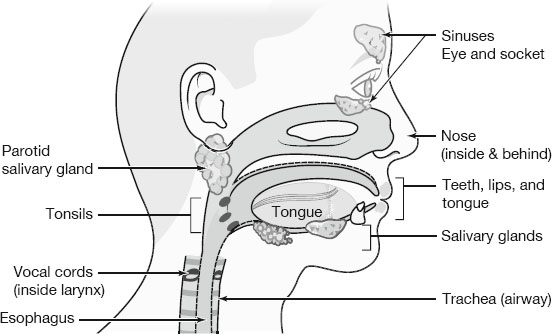
FIGURE 12-1. Possible damage to bone and soft tissues of the head and neck (excluding the brain) (©Alexʼs Lemonade Stand Foundation, 2025)
A labeled anatomical diagram of the human head and neck in profile view, showing major structures of the respiratory and digestive systems along with glands. Key labels include sinuses and eye and socket at the upper face, nose (inside & behind) in the nasal cavity, and teeth, lips, and tongue in the oral cavity. The tongue is prominently highlighted inside the mouth. Surrounding the oral region are salivary glands, including the parotid salivary gland near the cheek. The diagram also points to tonsils in the throat area, vocal cords (inside larynx) in the upper airway, and the trachea (airway) leading downward. The esophagus is shown behind the trachea as part of the digestive tract. The illustration uses grayscale shading and arrows to clearly identify each structure, emphasizing the interconnected anatomy of the head, neck, and upper torso.
Young children who were given higher doses of radiation to the bony orbit (eye socket) of the eye to treat retinoblastoma or rhabdomyosarcoma close to the eye often have an altered appearance because the radiation causes the socket to grow less than the untreated socket. If the radiation is given to only one eye, the face appears more asymmetrical as the child grows.
Soft tissues
Children or adolescents treated with radiation for rhabdomyosarcoma, nasopharyngeal carcinoma, or sarcomas of the head and neck can have soft tissue (tendons, muscles, skin, fat, and connective tissue) damage as well as underlying bone damage in the irradiated areas. Soft tissue damage can include scarring and blood vessel damage in the irradiated tissues. This damage can reduce blood supply to the affected area that slows healing and weakens bones.
Children or adolescents with Hodgkin lymphoma who received mantle radiation (radiation to lymph node areas in the neck, chest, under the arms. and sometimes the belly) are also at risk for underdevelopment of the structures in the areas irradiated, typically resulting in slender necks, narrow chins, and shortened distance between the shoulders. Mantle radiation was used to treat Hodgkin lymphoma from the 1970s to the 1990s, but its use was stopped because of its many serious side and late effects. Subsequent research showed that more selective use of radiation was as effective and led to changes in how it is used to treat Hodgkin lymphoma specifically. However, the risk for subsequent malignancies including breast cancer may occur even in lower doses of radiation.
Blood vessels
Carotid artery disease and an increased risk of stroke have been associated with radiation therapy to the neck in adults. Studies to determine whether survivors of childhood cancer who received radiation therapy to the neck are at risk for developing carotid artery disease are currently being conducted (see Chapter 13, Heart and Blood Vessels).
Sinuses
Most children and adolescents treated with chemotherapy and/or radiation suffer from serious damage to the mucous membranes in the nose and mouth. Many have severe ulcerations (mouth sores) that are painful and cause great difficulty with eating and drinking. For the majority of survivors, these sores heal, leaving no lingering difficulties. However, for a small group, mucous membrane changes persist. Scarring in the nasal passages can interfere with normal mucus production and drainage, resulting in chronic sinus infections. Survivors can develop a constant post-nasal drip or a thick, continuous drainage from the nose. Other late effects include pain in cheekbones or above eyebrows, headaches, and halitosis (bad breath).
These effects tend to be dose-related. The people most likely to suffer from painful sinus infections are those who received high-dose radiation to the mouth and sinuses. Children or adolescents who were given more than 4000 cGy to these areas are most likely to have these problems.
Teeth
The development and appearance of teeth can be affected by both radiation and chemotherapy. Radiation is more likely to cause problems when given in high doses to young children. Teeth that have not fully developed and have not yet erupted are also at risk. The damage to these tooth buds can be significant and result in the non-development of adult teeth.
Abnormalities of the teeth that can develop from radiation or chemotherapy include the following:
Absent teeth
Abnormally small teeth
Short or thin roots
Small crowns
Poor bite (called malocclusion)
Poor enamel
Incomplete calcification (not enough minerals and calcium for healthy tooth enamel)
Frequent cavities
Enlarged pulp chambers (space in center of tooth containing nerves and blood supply)
Baby teeth that don’t fall out at the usual time during a child’s development
Mouth
Saliva is a mix of secretions from the parotid gland (near the ear), sublingual gland (under the tongue), and submandibular gland (under the lower jaw) that lubricates the mouth and aids in taste and digestion. Decreased production of saliva (called xerostomia) affects overall well-being in many ways, including dry mouth. Dry mouth can result in food not tasting good, teeth riddled with cavities, bad breath, and bone decay.
The dose of radiation to the saliva-producing glands and the percentage of the glands that are radiated affect the amount of saliva produced. Children treated for head or neck soft tissue sarcomas are most at risk. Most glands regain the ability to secrete if the total dose of radiation to the area was less than 4000 cGy. Graft-versus-host disease of the salivary glands can also affect saliva production.
Survivors with persistent problems with dry mouth can find information and support from the Sjögren’s Foundation at (800) 4-SJOGREN or www.sjogrens.org.
Taste
Changes in taste continue to bother some survivors long after treatment ends. Radiation can cause long-term taste problems because it can destroy the taste buds, as well as cause dry mouth by damaging the salivary glands. Lack of saliva affects the taste buds’ ability to identify particular tastes.
Esophagus
The esophagus is the tube that carries food and liquids from the mouth to the stomach. In Hodgkin lymphoma survivors treated with mantle radiation and others treated with direct radiation to the chest, neck, and spine, stomach acid can flow up into the esophagus, causing a burning sensation and tissue irritation. Over time, the esophagus can swell, causing an inflammation called esophagitis. This condition can be painful and can reduce the desire to eat. Barrett’s esophagus (which is changes in the cells of the esophagus) can occur in association with reflux in those whose gastrointestinal tracts were irradiated.
Severe esophagitis can lead to bleeding from the inflamed portion of the esophagus or the formation of scar tissue. This narrowing of the esophagus—called esophageal stricture—is often accompanied by choking and delayed stomach emptying causing discomfort.
In addition, some survivors have trouble swallowing because of damage from a tumor, prolonged vomiting from chemotherapy that damaged the esophagus, or complications from surgery or a tumor in the part of the brain that controls swallowing.
Vocal cords
Radiation to the neck can cause damage to the vocal cords and changes in the voice. The voice can become high and thin and hoarse as a result of doses of 3000 cGy or more of radiation to the neck. However, each survivor is different, and long-term follow-up is important.
Esophageal strictures
Esophageal stricture is a narrowing of the esophagus that can happen due to the effects of radiation to the head and cervical and thoracic regions. In addition, survivors of hematopoietic cell transplant who develop GVHD may develop gastroesophageal strictures.
Gastroesophageal reflux (GER)
Gastroesophageal reflux (GER) occurs when the end of the esophagus (food tube) does not close completely and allows acid and food in the stomach to back up into the esophagus. This can cause pain and discomfort (heartburn) and damage the lower esophagus. The damage can cause narrowing of the esophagus and over time, cancer. Other symptoms of GER include: non-cardiac pain, nausea, sore throat or feeling of a lump in your throat or difficulty swallowing, and asthma symptoms (coughing, wheezing, difficulty breathing). Occasional acid reflux can be manageable at home, but continuous (chronic) acid reflux can damage your esophagus tissue over time and might need treatment.
Table of Contents
All Guides- Acknowledgements
- Contributors
- Foreword
- Preface
- 1. Survivorship
- 2. Emotions
- 3. Relationships
- 4. Navigating The System
- 5. Staying Healthy
- 6. Genetic Testing And Childhood Cancer
- 7. Diseases
- 8. Fatigue
- 9. Brain And Nerves
- 10. Hormone-Producing Glands
- 11. Eyes And Ears
- 12. Head And Neck
- 13. Heart And Blood Vessels
- 14. Lungs
- 15. Kidneys, Bladder, And Genitals
- 16. Liver, Stomach, And Intestines
- 17. Immune System
- 18. Muscles And Bones
- 19. Skin, Breasts, And Hair
- 20. Subsequent Malignancies
- About The Editors