
The liver is the body’s largest internal organ and one of the most complex. This wedge-shaped organ is located beneath the rib cage in the upper-right part of the abdomen. The liver performs thousands of functions that are essential to life. It transforms food into energy, removes toxins (e.g., alcohol and drugs) from the body, keeps blood clotting normally, and makes proteins. It regulates the supply of essential minerals and vitamins and also produces bile, a fluid needed for proper digestion. In addition, the liver helps filter many chemical substances and waste products from the blood.
Risk factors for damage to the liver
Hepatitis
For survivors who received treatments after 1990s, the risk for significant hepatic toxicity is low (Bardi et al, 2021). Inflammation of the liver is called hepatitis. There are many possible causes of liver inflammation in childhood cancer survivors, including infection by viruses and damage from radiation and/or chemotherapy drugs. However, inflammation of the liver is relatively rare in survivors, especially in those treated for cancer in recent years.
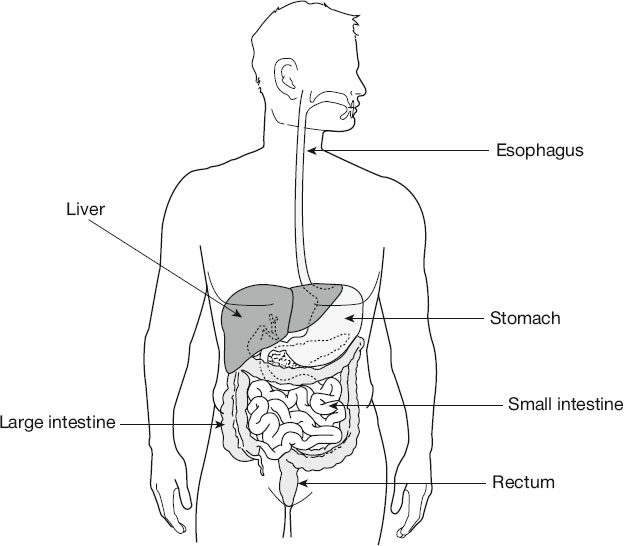
FIGURE 16-1. Location of the liver, stomach, intestines and rectum (©Alex’s Lemonade Stand Foundation, 2025)
Viral hepatitis
Hepatitis A. Hepatitis A is an infection caused by the hepatitis A virus (HAV), which is usually spread by contamination of food by human waste. Although in 2020, there were 15,000 new cases of HAV, in 2022 less than 4,500 new cases were reported, and as of 2023 the number was almost zero (http://www.cdc.gov/hepatitis). It is most common in international travelers, sexually active homosexual men, intravenous drug users, and daycare workers. Most healthy people who get hepatitis A have no long-term consequences from the infection. There is an effective vaccine that prevents hepatitis A infections. This type of hepatitis is not a late effect of childhood cancer.
Hepatitis B. Hepatitis B is an inflammation of the liver caused by the hepatitis B virus (HBV). Approximately 1 million Americans have chronic hepatitis B infections, including survivors who received blood transfusions prior to 1972 (blood products were not screened for this virus before 1972). In 2022 in the United States, 2,126 acute hepatitis B cases were reported but there was an estimated total of 13,800 acute hepatitis B virus (HBV) cases rates (http://www.cdc.gov/hepatitis). There is now an effective vaccine that prevents hepatitis B infections. The blood supply for transfusions is now well screened, and healthcare workers are routinely vaccinated.
Hepatitis C. Hepatitis C is an inflammation of the liver caused by the hepatitis C virus (HCV). HCV was spread by blood transfusions that were received prior to effective testing of blood products and is currently spread by sharing needles for illicit intravenous drug use, and, less commonly, through sexual intercourse. Since 2020, the number of individuals diagnosed with Hepatitis C has decreased substantially, and may be due to under-reporting due to COVID, less risky health behaviors, and vaccination rates (http://www.cdc.gov /hepatitis). There is no vaccine for HCV.
If you are infected with HCV, there are five possible outcomes:
Your body’s immune system may eliminate the virus and you will have no further problems (this happens in 15 to 25 percent of persons infected).
You may have a lifelong infection, but your liver will sustain no damage.
You may develop liver inflammation, with or without symptoms.
You may develop progressive inflammation and scarring of the liver. When this scarring (fibrosis) spreads throughout the liver and causes lumps, it is called cirrhosis. This process occurs over many years and usually results in symptoms. It can eventually lead to liver failure.
In rare cases, liver cancer develops, but only after years of inflammation from chronic hepatitis C and cirrhosis.
Liver fibrosis
Liver fibrosis (excessive formation of scar tissue in the liver) develops from liver inflammation, which has a variety of causes. Liver toxicity can be measured by liver function tests during or after cancer treatment ends.
The risks for liver fibrosis in cancer survivors are:
Chronic viral hepatitis
Liver irradiation (abdominal radiation on the right side)
High doses of drugs that can cause liver toxicity (e.g., methotrexate, 6-MP, 6-TG, dactinomycin)
Hematopoietic cell transplantation
Risk factors for development of liver fibrosis due to radiation:
amount of the liver that was irradiated
radiation dose
younger age at treatment
at highest risk are those who had higher doses of radiation to the entire liver
Chemotherapy can also cause liver fibrosis. Very few children who received lower doses of methotrexate develop fibrosis. Even less frequently, mercaptopurine (6-MP), thioguanine (6-TG), and dactinomycin can affect the function of the liver.
Survivors of hematopoietic stem cell transplantation (e.g., bone marrow, peripheral stem cell, or cord blood transplants) may have several risk factors for chronic liver disease, including HCV infection, iron overload (hemochromatosis), and chronic (ongoing) graft-versus-host disease (GVHD) (when the graft, marrow or stem cells from the donor reacts against the host who is the person receiving the transplant). Liver damage can develop rapidly in transplant survivors.
Signs and symptoms of damage to the liver
Hepatitis C and liver fibrosis
Because HCV can silently damage the liver, you may not be aware of the infection until late, when it has already caused fibrosis and corresponding symptoms of nausea/vomiting, fluid in abdomen, and enlarged liver.
Symptoms of hepatitis C include the following:
Abdominal pain
Darkening of the urine
Fatigue
Fever
Jaundice (yellowing of eyes and skin)
Nausea
Lack of appetite
Vomiting
Screening and detection for liver damage
Most institutions recommend three blood tests (ALT, AST, and bilirubin – see definitions in glossary) to assess the health of the liver on entry to a long-term follow-up clinic and on an ongoing basis, if necessary. All survivors of childhood cancer regardless of treatment should also have a serum ferritin test, a blood test that measures the amount of ferritin (blood protein that contains iron) in the blood and is a check for iron-deficiency anemia. During your annual physical examination, your healthcare provider should palpate (feel) your abdomen to check for an enlarged liver. Any abnormal findings should result in further evaluation including an MRI of the liver to assess for excessive iron deposits in the liver. A referral to a gastroenterologist (a medical doctor specializing in digestive diseases and disorders) may be necessary for further evaluation and treatment.
Medical, surgical, and psychological management
Although currently the risk for developing hepatitis C is low, the following may be helpful for those survivors experiencing this chronic illness. There is no specific treatment for acute HCV (HCV that develops suddenly and goes away after the body successfully fights it off). As noted above, in 15-25 percent of people infected, their immune system eliminates the virus, and they have no further problems.
See a specialist. Survivors who experience chronic (long-lasting) HCV should see a specialist who treats liver problems/diseases. There are a number of medications to treat chronic HCV, including interferon alpha, which stimulates the immune system to fight the infection, and ribavirin, an antiviral antibiotic, which are usually given together. This combination treatment is effective in up to half of patients. Treatments for HCV may change or evolve over time, so keep in touch with a specialist if you have HCV to learn of the newest options.
Treatments for iron overload. Survivors who have excessive liver deposits based on ferritin levels and MRI findings may benefit from routine phlebotomy or chelation for iron overload (hemochromatosis).
Surgery. Some people who have had HCV infections for many years need a liver transplant, because the liver becomes so damaged that it can no longer perform its crucial functions.
Take precautions. If you have HCV or chronic liver fibrosis, the following can help to protect your liver:
Don’t drink alcohol—it greatly increases damage to the liver.
Don’t take over-the-counter medications, such as Tylenol® (acetaminophen) or Advil® (ibuprofen), herbal or dietary aids, or prescription medications, without first discussing them with your healthcare provider.
Get vaccinated against hepatitis A and B
See your healthcare provider regularly.
Transmission through sexual intercourse. HCV can be spread to a partner by sexual intercourse, so it is important to use barrier protection, such as condoms. Because there is no vaccine against HCV, a sexual partner of a survivor with HCV can also get the infection. Therefore, your sexual partner should be periodically screened for HCV. Rarely, HCV can be transmitted to an infant during pregnancy. It is important that female survivors with HCV tell their obstetrician and family physician about the infection.
Counseling and support. Counseling with a healthcare provider should be provided if you test positive for HBV or HCV to help you learn about and cope with these chronic diseases. Many people with HCV infections find comfort participating in support groups, which are available in many communities because HCV is so widespread.
For more information about HCV, visit the U.S. Centers for Disease Control and Prevention website at https://www.cdc.gov/hepatitis/, or call 1- 800-CDC-INFO (1-800-232-4636).
The American Liver Foundation has an informative website at www.Liverfoundation.org
Table of Contents
All Guides- Acknowledgements
- Contributors
- Foreword
- Preface
- 1. Survivorship
- 2. Emotions
- 3. Relationships
- 4. Navigating The System
- 5. Staying Healthy
- 6. Genetic Testing And Childhood Cancer
- 7. Diseases
- 8. Fatigue
- 9. Brain And Nerves
- 10. Hormone-Producing Glands
- 11. Eyes And Ears
- 12. Head And Neck
- 13. Heart And Blood Vessels
- 14. Lungs
- 15. Kidneys, Bladder, And Genitals
- 16. Liver, Stomach, And Intestines
- 17. Immune System
- 18. Muscles And Bones
- 19. Skin, Breasts, And Hair
- 20. Subsequent Malignancies
- About The Editors