
Childhood Cancer Survivors
Hodgkin Lymphoma
Hodgkin lymphoma (which used to be called Hodgkin’s disease) accounts for 7 percent of all cancers in children in the United States. The disease, very rare in children younger than age 5, is most commonly diagnosed in 15- to 19-year-olds. It occurs more often in boys than girls in patients younger than age 10, although in adolescence, the incidence is slightly higher in females than males. Approximately 94 percent of children and adolescents treated today with the current methods (listed below) survive their disease.
Description
Hodgkin lymphoma, first described by Thomas Hodgkin in 1832, is a cancer of the lymph system. This system is made up of lymph vessels throughout the body that carry a clear liquid called lymph. Throughout this network are groups of small organs called lymph nodes that make and store lymphocytes—cells that fight infection. Lymph tissue is found throughout the body, so Hodgkin lymphoma can be found in almost any organ or tissue, such as the liver, bone marrow, or spleen.
Treatment
Treatment for Hodgkin lymphoma is risk-based, and usually involves multiagent chemotherapy with or without low-dose radiation. Risk is determined by the stage of the disease, symptoms, and/or the presence of bulky disease (i.e., a large mass).
The goal of treatment for Hodgkin lymphoma is to eliminate the disease with the smallest amount of long-term problems. The method of treatment is based on stage of the disease, the age of the child or teen, and possible long-term effects, called risk-based treatment.
Historically, children and adolescents diagnosed with Hodgkin lymphoma were treated first with surgery (i.e., removal of the spleen), chemotherapy, and high-dose radiation. Current treatment usually involves multiagent chemotherapy with or without low-dose radiation. Surgery is performed rarely, in certain cases.
Some clinical trials include stem cell transplantation for recurrent disease. The intensity and duration of chemotherapy and the location and amount of radiation are based on risk factors.
Radiation
Figure 7-1 shows the areas of the body that may be irradiated in children or adolescents with Hodgkin lymphoma. Typically, only one field is used for localized disease.
In the 1960s and 1970s, higher doses of radiation were given to children and teens. Survivors treated prior to the 1990s have very different late effects than those treated more recently. Researchers have worked diligently to fine-tune protocols to give children and adolescents only the amount of radiation treatment needed for cure and to minimize late effects. Today it is much more common to receive lower doses of radiation and Intensity Modulated Radiation Therapy and/or Proton Radiation than 20 years ago.
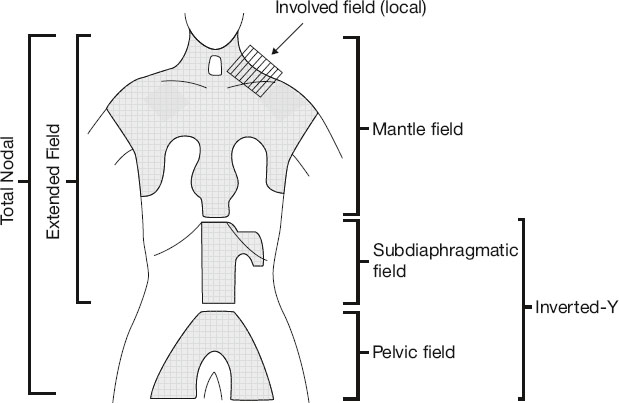
FIGURE 7-1. Radiation fields for Hodgkin lymphoma: local involved field, extended field, total nodal field (©Alexʼs Lemonade Stand Foundation, 2025)
A medical diagram illustrating radiation treatment fields on a human torso outline. It shows different regions labeled for targeted therapy: at the top near the neck, an Involved field (local) is marked with diagonal stripes. Below that, the Mantle field covers the chest and shoulders, shaded with a grid pattern. Further down, the Subdiaphragmatic field spans the upper abdomen, and the Pelvic field covers the lower abdomen and pelvic area. On the left side, brackets indicate Total Nodal and Extended Field, while on the right, another bracket groups the Subdiaphragmatic and Pelvic fields under Inverted-Y. The diagram uses simple outlines and shading to differentiate treatment zones for radiation therapy planning.
Chemotherapy
For decades the standard treatment for Hodgkins lymphoma was chemotherapy and consolidated radiation therapy. Today immunotherapy is being incorporated with some of the old chemotherapy drugs. Radiation is not always given but when it is, targeted treatment is the goal to limit healthy tissue exposure.
Today there are new drug studies directed at immunotherapy to reduce the long-term side effects of standard treatment. It is too early to comment now (2023) regarding results of these studies and whether this will become the new standard of treatment.
Late effects of treatment of Hodgkin Lymphoma
Much is known about possible late effects of treatment for Hodgkin lymphoma because so many children and adolescents survive the disease. Recent treatments have decreased the risk of serious late effects among Hodgkins’ survivors. The following information briefly outlines some common and uncommon late effects from treatment. Remember that you may develop none, a few, or several of these problems in the months or years after treatment ends.
Obstructions and infections. Splenectomy is rarely performed today. Late complications after a splenectomy (surgery to remove the spleen) are adhesions and intestinal obstruction. In addition, bacterial sepsis (massive infection) occurs in some patients who had their spleen removed or irradiated. For more information, see Chapter 17, Immune System.
Growth. Radiation can also cause significant late effects in survivors. The growth may be slowed in prepubertal children who receive spinal radiation. Children who are past puberty are usually not as affected as younger children. For more information, see Chapter 18, Muscles and Bones.
Dry mouth and narrowed esophagus. If the jawbone is in the radiation field, malfunctioning salivary glands can cause dry mouth and tooth decay. Mantle radiation can also result in delayed or arrested tooth development. Mantle radiation is a technique used in 1970s to the 1990s which treated a large area of the neck, chest, armpits and mediastinum (area between the lungs) in order to cover all areas with cancer involvement (See Figure 7.1). Mantle radiation is rarely used today in current treatment.
Current treatment is Involved Field Radiation Therapy (IFRT) which delivers radiation to only those areas of the body involved by lymphoma and is more precise and limits exposure to healthy tissue. Another effect that can occur several years after radiation in chest/neck area is esophageal strictures (which is narrowing of the tube between the mouth and the stomach). Symptoms are difficulty swallowing or needing to drink liquid to help swallow solid food. For more information, see Chapter 12, Head and Neck.
Thyroid problems. Hypothyroidism in Hodgkin lymphoma survivors treated with neck/chest radiation is common. Other possible problems are thyroid nodules, hyperthyroidism, and thyroid cancer. For more information, see Chapter 10, Hormone-Producing Glands.
Osteonecrosis. Some patients who were irradiated and also received chemotherapy that included prednisone develop osteonecrosis (destruction of blood vessels that go to the bones). Osteonecrosis can develop during treatment, but it also can occur years after treatment ends. This condition weakens bones and increases the risk of fractures. For more information, see Chapter 18, Muscles and Bones.
Lung damage. Radiation to the chest can damage the lungs, especially in survivors who also received bleomycin. The extent of the injury depends on the total amount of radiation, the amount given each day (fraction size), and the amount of lung tissue in the radiation field. For more information, see Chapter 14, Lungs.
Heart problems. Chest radiation (especially in combination with doxorubicin) can affect how well the heart works. Children or adolescents who received chest/whole lung radiation are at risk for cardiac problems ranging from EKG changes (with no symptoms) to life-threatening pericarditis (which is inflammation of the pericardium, the sac surrounding the heart). Other injuries to the heart include underdevelopment of the blood vessels, coronary artery disease, thickening of the pericardium, valve damage, and accelerated atherosclerosis. Treatment with anthracyclines also increases the risk for heart problems. For more information, see Chapter 13, Heart and Blood Vessels.
Fertility. After pelvic radiation, sterility or changes in fertility can occur in girls. A young ovary can tolerate more radiation than can an older ovary. Girls whose ovaries are radiated during puberty or after are more at risk for ovarian problems, including infertility and early menopause.
In males, functioning of the testes may be affected by pelvic radiation. Pelvic radiation can cause temporary oligospermia (a decrease in the number of sperm) or azoospermia (no sperm). If the testes are not in the field of radiation, they are usually unaffected.
Chemotherapy can also affect fertility in males. Usually, hormone- producing cells of the testes function well after therapy, so boys continue to grow and have a normal puberty. For more information about fertility, see Chapter 10, Hormone-Producing Glands, and Chapter 3, Relationships.
Reynaud’s syndrome. Reynaud’s syndrome (when fingers and toes become icy, white, and plump when exposed to cold) is a rare late effect of patients treated with vinblastine (Velben®) and bleomycin.
Secondary cancers (subsequent malignancy). One of the most serious late effects of treatment for Hodgkin lymphoma is secondary cancers. Some survivors develop either AML (acute myelogenous leukemia) or its precursor—pancytopenia myelodysplastic syndrome. The highest incidence of secondary leukemia is 5 to 10 years after treatment with chemotherapy. After 10 years, it is rarely seen. Solid tumors in the lungs, genitourinary tract, breasts, and thyroid sometimes occur after treatment of these areas with radiation. The risk of developing these cancers increases with time.
The risk of developing breast cancer after chest radiation for Hodgkin lymphoma has been estimated to be as high as 35 percent at 50 years of age, depending on radiation dose and age at diagnosis. The greatest risk of breast cancer appears to be in girls treated between the ages of 10 and 16. Thus, all female survivors of Hodgkin lymphoma should have routine mammograms starting 8 years after radiation or at age 25 (whichever occurs last) and have regular breast exams by their healthcare provider.
For more information, see Chapter 20, Subsequent Malignancies.
Table of Contents
All Guides- Acknowledgements
- Contributors
- Foreword
- Preface
- 1. Survivorship
- 2. Emotions
- 3. Relationships
- 4. Navigating The System
- 5. Staying Healthy
- 6. Genetic Testing And Childhood Cancer
- 7. Diseases
- 8. Fatigue
- 9. Brain And Nerves
- 10. Hormone-Producing Glands
- 11. Eyes And Ears
- 12. Head And Neck
- 13. Heart And Blood Vessels
- 14. Lungs
- 15. Kidneys, Bladder, And Genitals
- 16. Liver, Stomach, And Intestines
- 17. Immune System
- 18. Muscles And Bones
- 19. Skin, Breasts, And Hair
- 20. Subsequent Malignancies
- About The Editors